
Shadow of the Holy Book
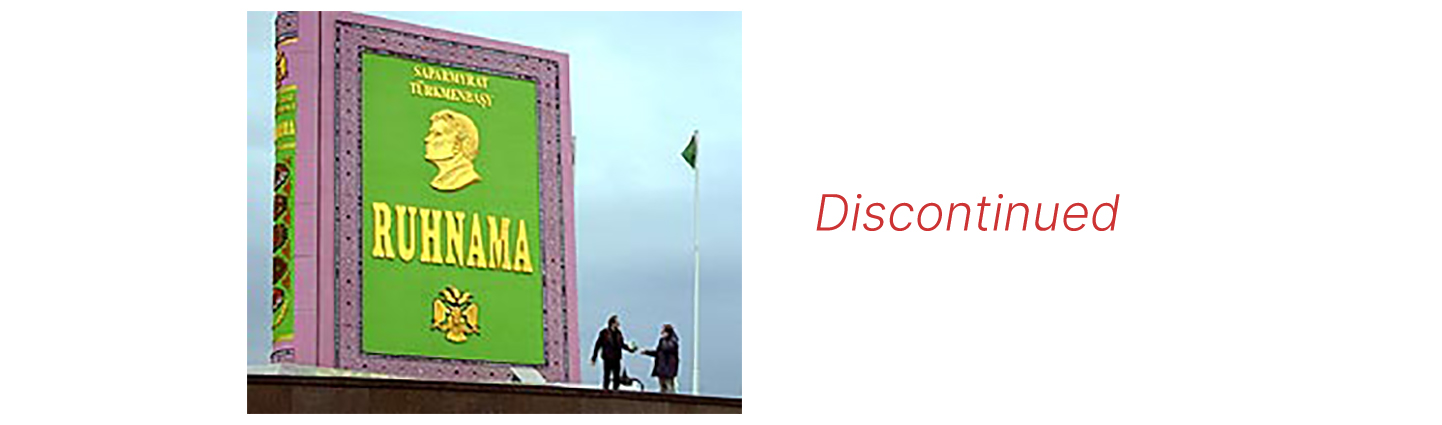
This high-spirited political satire exposes the complicity of multinational corporations in supporting and legitimizing Saparmurat Niyazov, the late dictator of Turkmenistan and one of the world’s most egregious violators of human rights. Niyazov, a self-appointed "President for Life," transformed the remote Central Asian republic into one of the most oppressive, megalomaniacal, and bizarre regimes in recent history. Turkmenistan, which borders Kazakhstan, Uzbekistan, Afghanistan, and Iran, is also home to one of the world’s largest oil and natural gas reserves. Such resource endowments have attracted world leaders and multi-billion-dollar corporations who willingly set aside their morals and knowingly propped up the regime to secure highly profitable business deals.
The ‘holy book’ in the film’s title refers to the Ruhnama, written by Niyazov, is a mixture of legend and his own delusional thinking, serving as a central part to his dictatorship, even more so than Mao’s little red book. The Ruhnama was fully integrated into the Turkmen educational system, taught in literature and math classes, memorization is even required to obtain a driving license. Desiring to be the 13th Prophet of Islam, Niyazov angered many of the country’s Muslim religious leaders with his attempts to make the Ruhnama as prominent as the Quran, and those who spoke out were imprisoned. Why then has this ‘holy book’ been translated into forty languages, paid for by some of the world’s largest corporations’ Siemens, Daimler-Chrysler, Caterpillar, John Deere, Bouygues, among many others, have all prostrated themselves before this preposterous screed.
Shadow of the Holy Book reveals that the royalties these companies paid the Niyasov regime never found their way to the impoverished Turkmen people. Instead, the profits were squandered on embellishing the country’s capital of Ashgabat with gold statues of Niyasov and an enormous, illuminated sculpture of the Ruhnama in the central square. The contractors for these monstrosities were, unsurprisingly, the same companies who translated the book.
Beyond Ashgabat, the rest of Turkmenistan is a barren desert, its scant water siphoned off to feed the capital’s incongruous fountains and green lawns. Outside the capital, there is widespread child labor, no health care and endemic unemployment. The young flock to the city in search of employment, many of whom end up in prostitution.
The filmmakers speak with Turkmeni dissidents, journalists and human rights advocates, now either in jail or exile. Like other totalitarian leaders, Niyasov ran a state-of-the-art security apparatus, with everything from surveillance cameras to electrodes, supplied by multinational corporations friendly to his regime. When the filmmakers, in the style of Michael Moore, try to interview the CEOs of these corporations, they are met by locked doors, hang ups and even the police.
In 2006, Niyasov died of a sudden heart attack, providing a brief window of opportunity to democratize the political system. But, the international community and the multinational corporations rallied around the new dictator, Gurbanguly Berdymuhammadov, who bears an uncanny physical resemblance to the old. Fittingly, he is also said to be writing his own book.
"Funny and Confrontational"
John Anderson, Variety
"Five Inspirational Stars for a docugation gone surreal, this grows on me, in that funny megalomaniacal way"
Peter Wintonick, POV Magazine, Canada
"Shadow Of The Holy Book combines interviews with Turkemen dissidents, human rights activists and Western corporate representatives with pseudo-television newscasts and footage from the country to peel off the mask of respectability worn by companies that put profits ahead of morality and common sense."
Eric Freedman, Assistant Dean of International Studies and Associate Professor of Journalism, Michigan State University
Shadow of the Holy Book
