
Revolution '67
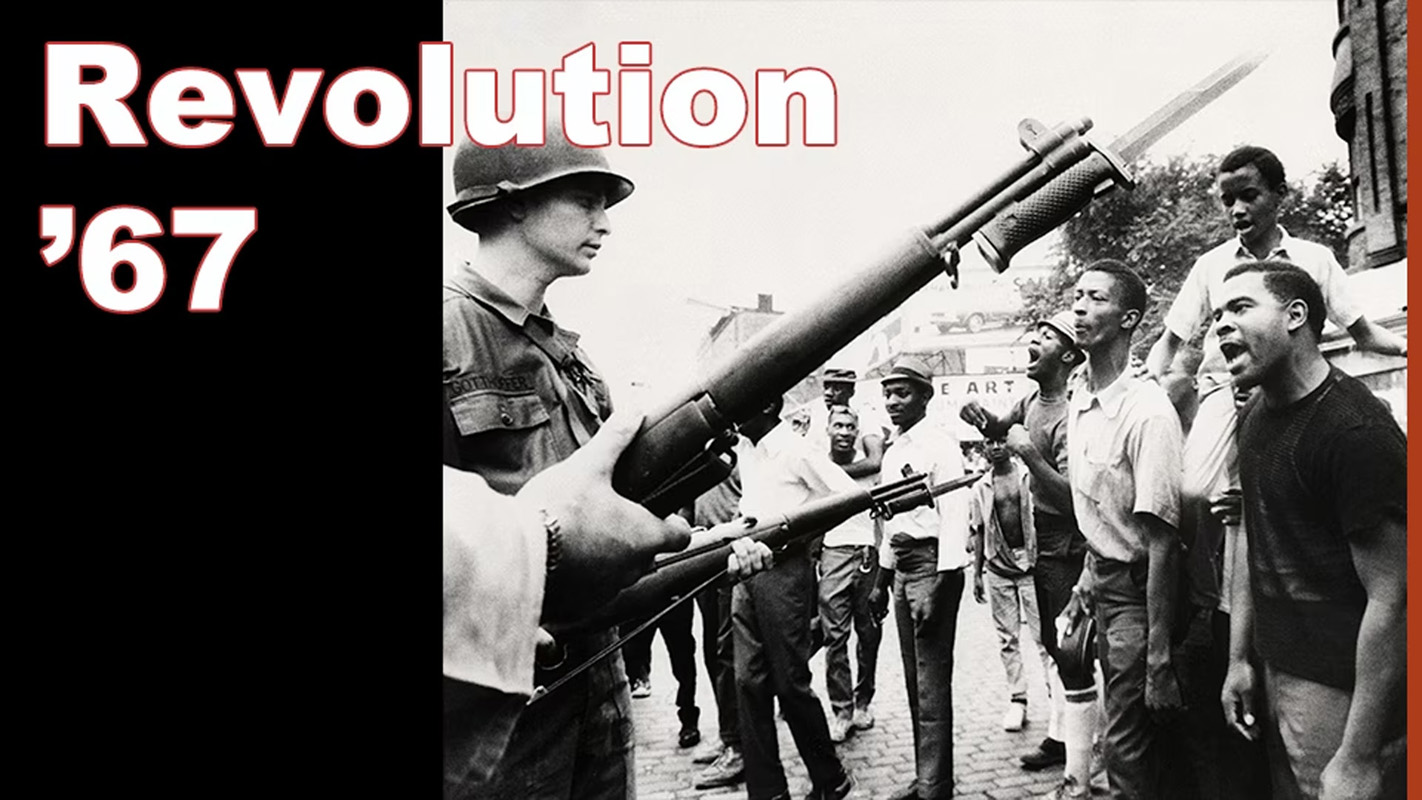
Revolution ‘67 focuses on the explosive urban rebellion in Newark, New Jersey, in July 1967, to reveal the long-standing racial, economic, and political forces which generated inner city poverty and perpetuate it today. Newark residents, police, officials, and urban commentators, including writer/activist Amiri Baraka, journalist Bob Herbert, prominent historians, and 1960s activist Tom Hayden, recount the vivid, day-to-day details of the uprising. But they also trace those traumatic days back to decades of industrial decline, unemployment, job and housing discrimination, federal programs favoring suburbs over cities, police impunity, political corruption, and a costly, divisive overseas war. Americans should not have been surprised when race wars exploded, turning cities into combat zones, bringing Vietnam back home.
The spark igniting this firestorm of pent-up rage in Newark was, as is so often, an encounter between a Black man and the police. On July 12th, 1967, two white officers stopped a Black taxi driver for a minor traffic violation, beat him, and dragged him into the local precinct. A rumor spread rapidly through Black neighborhoods that the driver had died. Though this proved to be untrue, years of police brutality incited a crowd to rampage through the streets, breaking windows, and looting white-owned businesses reputed to cheat their Black customers. The next night, a mass protest meeting erupted into more widespread violence.
Mayor Hugh Addonizio, subsequently imprisoned for graft, panicked and called Governor Richard J. Hughes, who summoned the New Jersey National Guard. Tanks rolled through Newark's streets, Black neighborhoods were cordoned off with barbed wire, and check-points set-up. The police and Guard, untrained in crowd control, fired indiscriminately into housing projects, killing innocent bystanders. But the national press, including The New York Times and Life magazine, blamed the deaths on "Black snipers," demonizing young African American men as ruthless guerillas, the domestic equivalent of the Viet Cong. When later examined, 13,000 rounds of ammunition were fired by law enforcement during the so-called riots, while less than 100 rounds were found which could have come from the alleged snipers; no one was ever charged as a sniper. In all, 26 people died, 24 of them African American, and 725 were wounded during those six days in July.
Revolution ‘67 connects the Newark tragedy and the racial disturbances in Detroit, Watts, and over 500 other U.S. cities during the 1960s to decades of indifference and discrimination. Historian Clement A. Price points out that Newark had always functioned as a launching pad for newly arrived European immigrants, offering poverty wages, back-breaking factory jobs, and run-down housing in exchange for a chance to move on, up, and out. But the "racialization" of American society made it impossible for Southern Black Americans to follow this classic path to the "American Dream." Job and housing discrimination locked them into inner city ghettoes. Starting in the early 1900s, corporate disinvestment from the industrialized North to low wage states, and now "off-shore" to the developing world, left Newark without jobs, manufacturing, a tax base, and a future, walled off from America's unprecedented affluence.
Historian Kenneth T. Jackson explains how federal policies, such as cheap mortgages and tax deductions for home ownership, encouraged whites to abandon urban centers for the sprawling suburbs. Public and private investment poured into suburban housing, commercial development, and a massive superhighway network, neglecting urban renewal, industrial growth, and efficient public transportation. African Americans were barred from these suburbs by discriminatory lending policies, exclusionary housing covenants, and, of course, lower incomes. "White flight" from Newark became a stampede, accelerating after July 1967. Neighborhoods were "red-lined," block-busting was rampant, housing prices plummeted; many owners simply walked away from their homes which sold for as little as $100 at auction. Newark was discarded to the poor; not a single movie theater or supermarket remained open; once thriving streets became lined with pawnshops and loan sharks.
The 1968 Kerner Commission's definitive report on these urban disturbances recommended massive federal investment in inner-city jobs, education, housing, and anti-discrimination enforcement. However, the film's postscript, "Newark Today," reveals that by the 2007 broadcast marking the 40th anniversary of the insurrection, little had improved. The segment documents that the city's population had dropped from 450,000 in 1950 down to 277,000 by 2006, with mid-2000s unemployment and poverty rates remaining more than double the national average. Education gaps at the time were also stark: while 70% of students nationwide passed standard high school exit exams, only 20% did so in Newark. The film argues that downtown "renaissance" projects like publicly funded arts and sports centers primarily benefit politicians, bankers, and developers rather than the cities' neighborhoods. Political corruption also endured; Newark’s last three mayors leading up to the documentary, including Sharpe James, were all indicted, alongside a steady stream of councilmen, chiefs of staff, and police chiefs. Urban specialists in the film assert that without sustainable jobs and a strong middle class to demand quality public services, intergenerational poverty will continue to suppress citizen expectations. While some interviewees see hope in institutional reform, more radical voices argue it is time to mobilize from the grassroots up. Revolution '67 ultimately makes it clear that the underlying causes and consequences of the 1967 rebellion still haunt us.
Revolution '67 is a co-production of Bongiorno Productions Inc., the Independent Television Service (ITVS), and P.O.V./American Documentary Inc., in association with WSKG, with funding provided by the Corporation for Public Broadcasting (CPB).
"Here in Newark, we partnered with Revolution ‘67 to bring this insightful documentary to our community."
Cory A. Booker, Mayor of Newark, NJ
"Revolution ‘67 accurately and effectively captures the mood, the pain, the loss, the ambiguity, the fear and the continuing, impact of the violent unrest of the summer of 1967."
Lonnie G. Bunch, Founding Director, Smithsonian's National Museum of African American History and Culture
"Revolution ‘67 dramatically reminded us of what I have called ‘the awakening.’ I was fascinated by every moment of the documentary."
Brendan Byrne, former NJ Governor (Essex County Prosecutor in 1967)
"An outstanding portrait of the 1967 Newark rebellion-the kind of event that certainly could repeat itself in any US city in the coming period."
Chester Hartman, Director of Research, Poverty & Race Research Action Council, Washington, DC
"It is a documentary film like none other! Revolution ‘67 is, a bold, inquisitive, and important contribution...That, it sheds light on a complicated narrative about race, power, community agency, and memory secures its place among the finest, films of the genre."
Clement Alexander Price, Rutgers University
"A powerful film which provides a comprehensive analysis of the events in Newark. It defines the impact of numerous planning decisions at the local, state and federal levels, and the outcome of discriminatory practices in the real estate and finance industries. Should be mandatory viewing for anyone affiliated with Urban Studies or working in the field of Planning."
Brenda Kayzar, Urban Studies Program, Department of Geography, University of Minnesota
Revolution '67
Guides
Teaching Revolution '67 - A Curriculum for High Schools
Revolution '67 - Economics and Housing: What did African-Americans face in the first half of the 20th century?
Awards
2008 American Historical Association's John E. O'Connor Film Award
2008 Organization of American Historians' Erik Barnouw Award Honorable Mention
Biographies
Marylou and Jerome Bongiorno are Newark-based, award-winning, Emmy-nominated, husband-and-wife filmmakers whose fictional, documentary, and museum art films are widely distributed. The Bongiornos have garnered critical acclaim and numerous prestigious grants, fellowships, and prizes including an Erik Barnouw OAH Award and a John O'Connor AHA Film Award for Revolution '67.
Links
Filmmakers' Website and Revolution '67 main page
The 1968 Kerner Commission Revisited on Bill Moyer's Journal
More information from the Filmmakers' on the Hands-On High School Curriculum
Visit the Archive PBS website to learn more about Revolution '67


Ways to Watch
Educational Streaming
Recommended for Colleges, Universities, Government Agencies, Hospitals and Corporations
Community Screening
Short-term use for small groups, organizations, or high school classes (where no admission is charged)
Home Viewing
48-hour, personal rental for in-home use only, restrictions apply