
Unnatural Causes Episode 1: In Sickness and in Wealth
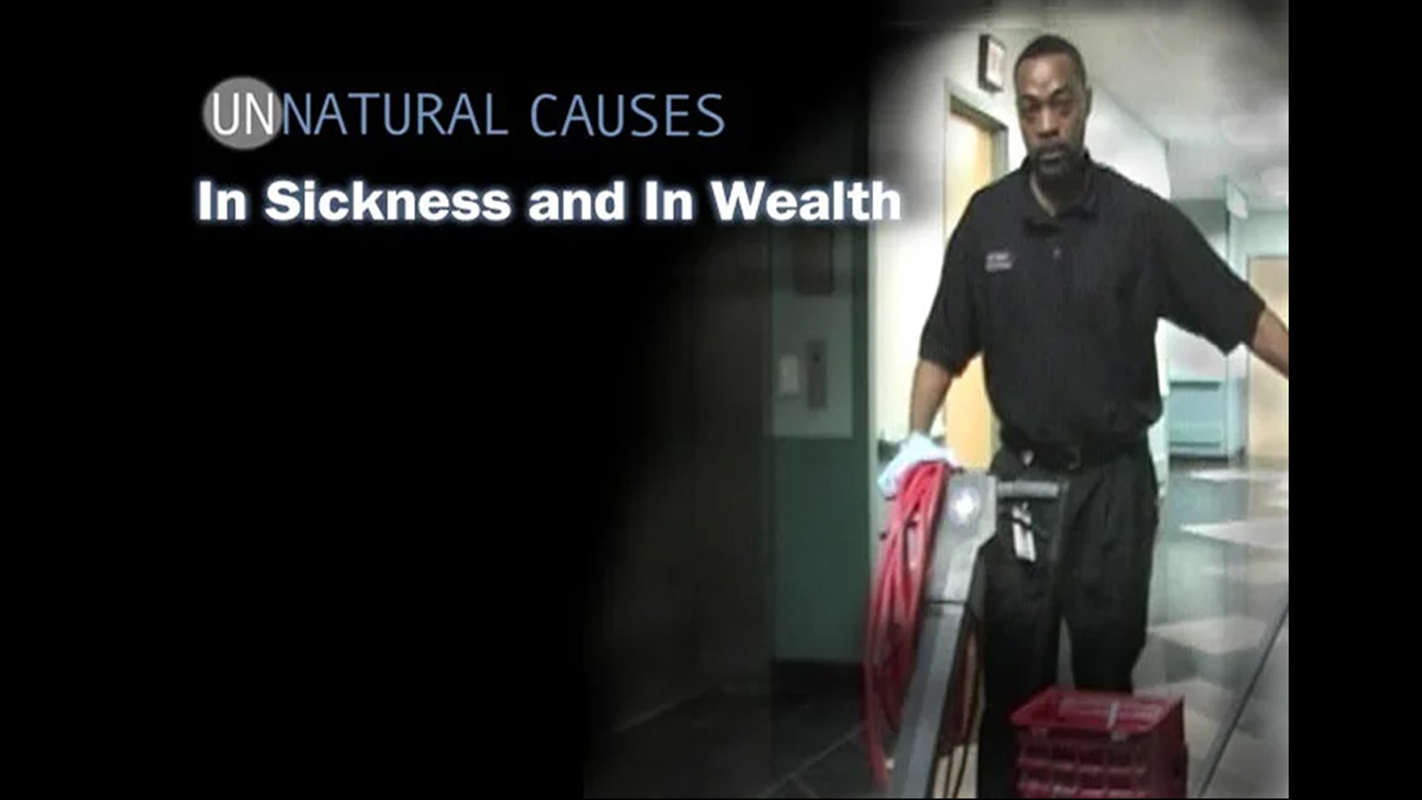
Episode 1 of the 7 part series Unnatural Causes: Is Inequality Making Us Sick?
What are the connections between healthy bodies, healthy bank accounts and skin color? Our opening episode travels to Louisville, Kentucky, not to explore whether medical care cures us but to see why we get sick in the first place, and why patterns of health and illness reflect underlying patterns of class and racial inequities.
The lives of a CEO, a lab supervisor, a janitor, and an unemployed mother illustrate how class shapes opportunities for good health. Those on the top have the most access to power, resources and opportunity – and thus the best health. Those on the bottom are faced with more stressors – unpaid bills, jobs that don’t pay enough, unsafe living conditions, exposure to environmental hazards, lack of control over work and schedule, worries over children – and the fewest resources available to help them cope.
The net effect is a health-wealth gradient, in which every descending rung of the socioeconomic ladder corresponds to worse health. And it’s not just the poorest among us who are suffering, but the middle classes too. Louisville Metro Public Health Department data maps reveal 5- and 10-year gaps in life expectancy between the city’s rich, middle and working-class neighborhoods. We also see how racial inequality imposes an additional burden on people of color.
But how do racism and class get under the skin? Experiments with monkeys and humans shed light on chronic stress as one culprit. Like gunning the engine of a car, constant activation of the stress response wears down the body’s system, resulting in higher rates of disease and early death.
Since the episodes release in 2008, wealth concentration in the U.S. has only grown more extreme. At the time, compared to other countries, the U.S. had the greatest income inequality — and the worst health. The top one percent of Americans owned more wealth than the bottom 90% combined; today that gap is even wider. Economic inequality was already greater than at any time since the 1920s — a record that's since been broken again. One out of every 5 children in the U.S. lived in poverty (21%) compared with approximately 4% of Sweden — a gap driven largely by social spending, which reduced child poverty by 70% in Sweden but only 5% in the U.S. (down from 26%). Child poverty has since fluctuated dramatically, briefly falling to a historic low before rebounding after pandemic-era aid expired — a reminder of how directly policy choices shape these numbers.
Solutions being pursued in Louisville and elsewhere focus not on more pills but on more equitable social policies. Louisville’s Center for Health Equity was the first of its kind: a collaboration between community members, local government, private business and health care organizations focusing on the social conditions that underlie our opportunities for health and wellbeing.
Unnatural Causes: Episode 1: In Sickness and in Wealth
Episode 1 of the 7 part series Unnatural Causes: Is Inequality Making Us Sick?
Companion Website
For Discussion Guides, Action Toolkits, Policy Guides, Backgrounders, Handouts and much more visit: www.unnaturalcauses.org
Discussion Guide
Discussion Guide for Unnatural Causes: Episode 1: In Sickness and In Wealth
Transcript
Transcript for Unnatural Causes: Episode 1: In Sickness and In Wealth

Ways to Watch
Educational Streaming
Recommended for Colleges, Universities, Government Agencies, Hospitals and Corporations
Community Screening
Short-term use for small groups, organizations, or high school classes (where no admission is charged)
Home Viewing
48-hour, personal rental for in-home use only, restrictions apply